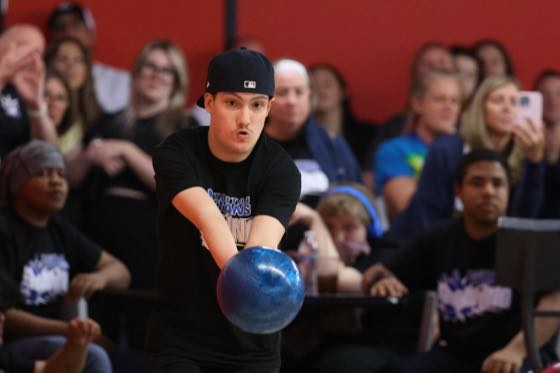
Read the eligibility criteria for each division below. Choose a division to jump directly to its requirements.
Cognitively Impaired (C.I.) Division
The MSHSL Adapted Athletics CI Division program is specifically intended for students with cognitive impairments who have medical clearance to compete in competitive athletics.
A student is eligible to compete in the CI Division by meeting criteria 1 or 2 below:
Eligibility Criteria #1
– The student qualifies for DCD special education services as outlined in Minnesota Rule: 3525.1333 DEVELOPMENTAL COGNITIVE DISABILITY
Definition:
“Developmental Cognitive Disability (DCD)” means a condition resulting in significantly below average intellectual functioning and concurrent deficits in adaptive behavior that adversely affects educational performance and requires special education and related services. DCD does not include conditions primarily due to a sensory or physical impairment, traumatic brain injury, autism spectrum disorders, severe multiple impairments, cultural influences, or inconsistent educational programming.
Criteria:
The team shall determine that a pupil is eligible as having a DCD and is in need of special education instruction and related services if the pupil meets the criteria in items A and B.
The pupil demonstrates below average adaptive behavior in school and home, and, if appropriate, community environments. For the purposes of this item, “below average” means: a composite score at or below the 15th percentile on a nationally normed, technically adequate measure of adaptive behavior; and documentation of needs and the level of support required in at least four of the seven adaptive behavior domains across multiple environments.
Systematic observation and parent input must be included as sources to document need and level of support.
All of the following adaptive behavior domains must be considered: daily living and independent living skills; social and interpersonal skills; communication skills; academic skills; recreation and leisure skills; community participation skills; and work and work-related skills.
Other sources of documentation may include checklists; classroom or work samples; interviews; criterion-referenced measures; educational history; medical history; or pupil self report.
The pupil demonstrates significantly below average general intellectual functioning that is measured by an individually administered, nationally normed test of intellectual ability.
Eligibility Criteria #2
– The student must have a diagnosed and documented cognitive impairment. Cognitively impaired refers to students with sub-average intellectual function defined by a Full Scale intelligence quotient of 70 or below, using a standardized, nationally-normed, technically adequate, and individually administered intelligence test.
Specific exclusions from CI competition:
A student becomes ineligible to participate in adapted athletics when they have attained a level of cognitive performance that exceeds the eligibility requirements.
Physically Impaired (P.I.) Division
The MSHSL has competitive interscholastic Physically Impaired (PI) competition. Students who are deemed fit to participate in competitive athletics from a MSHSL sports qualifying exam should meet the criteria below to participate in Adapted Athletics – PI Division.
The MSHSL Adapted Athletics PI Division program is specifically intended for students with physical impairments who are medically eligible to compete in competitive athletics. A student is administratively eligible to compete in the PI Division with one of the two following criteria:
The student must have a diagnosed and documented impairment specified from one of the two sections below: (Must be diagnosed and documented by a Physician, Physician’s Assistant, and/or Advanced Practice Nurse.)
- A Neuromuscular, Postural/Skeletal, Traumatic, Growth or Neurological Impairment which impacts motor function, modifies gait patterns or requires the use of prosthesis or mobility device (including but not limited to canes, crutches, walker or wheelchair).
- Cardio/Respiratory Impairment that is deemed safe for competitive athletics, but limits the intensity and duration of physical exertion such that sustained activity for over five minutes at 60% of maximum heart rate for age results in physical distress in spite of appropriate management of the health condition. (NOTE:) A condition that can be appropriately managed with appropriate medications that eliminate physical or health endurance limitations WILL NOT be considered eligible for adapted athletics.
Specific exclusions to PI competition:
The following health conditions, without coexisting physical impairments as outlined above, may not qualify the student to participate in the PI Division even though some of the conditions below may be considered Health Impairments by an individual’s physician, a student’s school, or government agency. This list is not all-inclusive and the conditions are examples of non-qualifying health conditions (other health conditions that are not listed below may also be non-qualifying for participation in the PI Division).
- Attention Deficit Disorder (ADD)
- Attention Deficit Hyperactive Disorder (ADHD)
- Emotional Behavioral Disorder (EBD)
- Autism Spectrum Disorders (including Asperger’s Syndrome)
- Tourette’s Syndrome
- Neurofibromatosis
- Asthma
- Reactive Airway Disease (RAD)
- Bronchopulmonary Dysplasia (BPD)
- Blindness
- Deafness
- Obesity
- Depression
- Generalized Anxiety Disorder
- Seizure Disorder, or other similar disorders.
NOTE: A student is not required to have an IEP, qualify for special education, or have a special education categorical disability of Physically Impaired in order to participate in the Physically Impaired division of adapted athletics.