
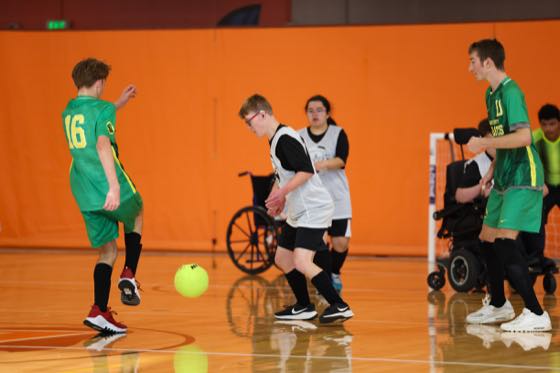
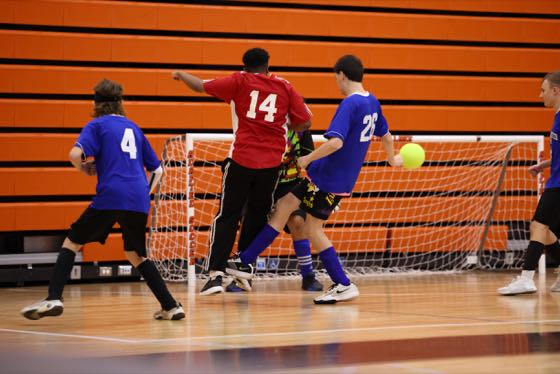
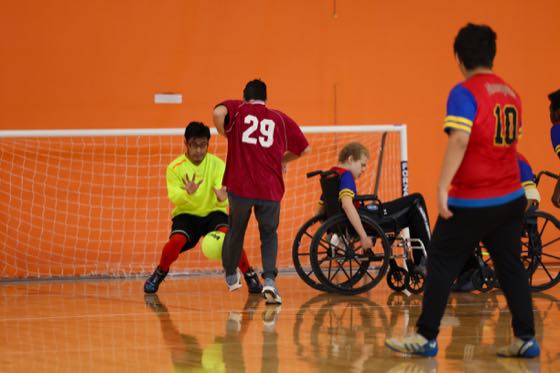
Adapted Soccer is a fall varsity sport played indoors on a varsity-size basketball court in a gymnasium. Teams compete in two divisions: C.I. (Cognitive Impairments) and P.I. (Physical Impairments).
The game ball is a size 5 felt indoor soccer ball. The ball is partially deflated to reduce its bounce. Prior to the game the referee will check the ball so that it does not bounce above the knee when dropped from shoulder height. The goals are 12 ft wide by 4 ft high and are placed against the end walls.
The ball may be played off the gymnasium walls and vinyl-covered, foam-padded borders, which keep it in play in front of benches and seating areas. When the ball goes out of play, the game restarts with an indirect free kick. There is no offside rule in Adapted Soccer. Teams play two 20-minute halves, with a five- to ten-minute intermission between them.
Teams compete within the conference during the regular season and playoffs. At the conclusion of conference play and playoffs, eight teams are seeded for the MSHSL State Adapted Soccer Tournament in November.


2026 Season
| Date: | Event(s): |
| 09/08/26 | Start of season (Practices Begin) |
| 09/17/26 | Start of Conference Games |
| 11/12/26 | End of Conference Season |
| 11/20/26 | MSHSL State Tournament Day 1 |
| 11/21/26 | MSHSL State Tournament Day 2 |
CI Division Rules Overview
Players and substitutions
- Teams play seven athletes: one goalkeeper, three defenders, and three forwards.
- Substitutions are allowed at five-minute intervals, during a timeout, or for an injured player.
Court direction
- Teams defend the same goal throughout regulation and overtime unless both coaches agree before the game to switch goals after the first period.
- If teams switch goals, they retain their second-period goals throughout overtime.
Kickoffs
- The ball must be stationary at the center of the court before the kick.
- The ball must be kicked forward and travel at least one full circumference to be in play.
- Players may not pass the ball backward or sideways to a teammate on a kickoff.
Free kicks
- An indirect free kick replaces situations that would require a drop ball in non-adapted soccer.
- Fouls such as a handball outside the penalty area result in a direct free kick for the opposing team. A goal may be scored directly from this kick without touching another player.
Goalkeepers
- Goalkeepers may catch, bat, swat, or kick the ball in the goal area. Once a goalkeeper picks up the ball, they may not kick it and must throw it into play.
- After making a save, or for a goalkeeper throw-in, goalkeepers must throw the ball into play within eight seconds.
- If a goalkeeper’s throw travels beyond the center line without touching another player, the opposing team receives an indirect free kick.
PI Division Rules Overview
Players and substitutions
- Teams play seven athletes: one goalkeeper, three defenders, and three forwards.
- Teams must have at least two athletes using wheelchairs, or one using a wheelchair and one using a walker, on the court. If a team is short one required wheelchair athlete, it must play one player short.
- Substitutions are allowed only during a dead ball, after a goal, or during a timeout.
Court direction
- Teams shall exchange goals after the first regular period of play and retain the second-period goals for all overtime periods of play.
Kickoffs
- The ball must be stationary at the center of the court before the kick.
- The ball must be kicked forward and travel at least one full circumference to be in play.
- Players may not pass the ball backward or sideways to a teammate on a kickoff.
Free kicks
- An indirect free kick replaces situations that would require a drop ball in non-adapted soccer.
- Fouls such as a handball outside the penalty area result in a direct free kick for the opposing team. A goal may be scored directly from this kick without the ball touching another player.
Goalkeepers
- Goalkeepers may run within the 10-foot goal crease. Outside that area, they must follow the no-running rule.
- After making a save, goalkeepers must throw the ball into play within eight seconds.
- If a goalkeeper’s throw travels beyond the center line without touching another player, the opposing team receives an indirect free kick.
Movement and ball control
- Wheelchair athletes may use their hands or feet to propel the ball, but may not use both.
- Running is prohibited. Players moving on foot must keep at least one foot on the floor at all times. Speed itself is not restricted; players may move quickly by sliding or dragging their feet, speed walking, or taking long steps.
- Wheelchair athletes’ speed is not restricted. However, initiating contact with a player who has established their position may be called for a “dangerous driving” foul.